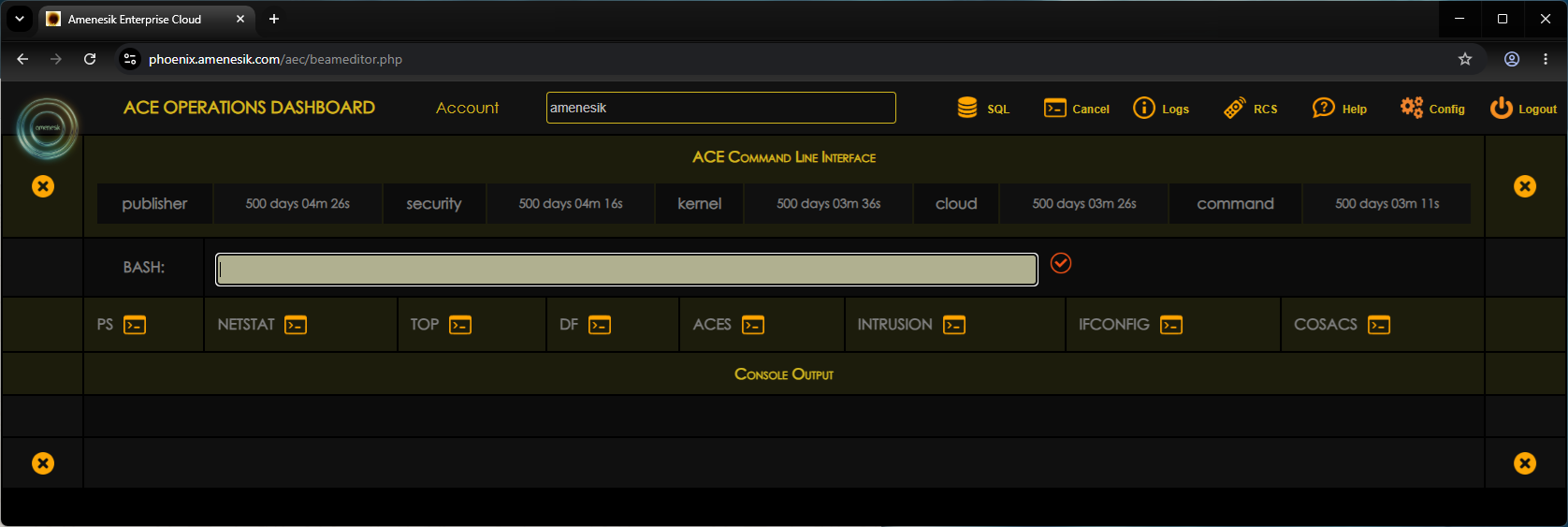
To mark the 500th day of continuous operational uptime, Amenesik would like to share the real story behind Phoenix that drives the Amenesik Enterprise Cloud.
Phoenix is not the story of a cloud platform. It is the story of an idea that has been evolving for decades.
The conventional view of software assumes that applications live within the boundaries of a computer. Whether running on a desktop, a server, or a cluster, the machine remains the fundamental unit of computation.
The architectural vision behind Phoenix challenged that assumption. The objective was to extend software design beyond the confines of the compute unit itself and to treat distributed infrastructure as a single operational environment. In this model, software objects and services become the primary building blocks, while physical location becomes largely irrelevant. The same logical system can operate on a single machine or across thousands of interconnected systems without changing its fundamental design.
To achieve this, a software generator was developed that could create the underlying operational components of the platform. Rather than assembling complex systems manually, the architecture itself became encoded in software. Consistency, resilience, and operational behavior were designed into the generated components from the beginning.
This approach eventually evolved into the Amenesik Cloud Engine, itself derived from CompatibleOne, an Apache-licensed open-source project, for which the technical architecture and the vast majority of the implementation were created by its principal designer. Supported through the European Basmati project, the platform became a Cloud Service Federation Platform, operating in production infrastructure hosted by OVH.
Then came the OVH datacenter fire.
The running platform, its operational environment, and its live databases were destroyed. While source code survived in Git repositories, the current operational state of the system was lost forever. For many software projects, such an event would have marked the end.
Instead, it demonstrated the value of the architectural approach.
Using surviving source repositories and an older core database backup, the platform was reconstructed. The generated components, the architectural model, and the design principles remained intact. The system could be rebuilt because its essential knowledge was embedded in the architecture itself rather than in a particular deployment.
From those ashes emerged Phoenix.
Today, Phoenix stands as both a production platform and a validation of the original vision. Its services are generated from the same architectural foundations and operate as a distributed cloud operating environment. The platform has delivered continuous service for hundreds of days without human intervention, quietly performing the functions for which it was designed.
This is why the phrase “Reliable by Design. Invisible in Operation.” is more than a slogan.
It is a description of the underlying philosophy.
The highest achievement of software is not that it attracts attention. It is that it becomes so dependable that users can forget it exists and simply rely on it. Phoenix was built on that principle, proven through adversity, and refined through operation.
Born from the ashes of disaster, Phoenix ultimately fulfils a far more ambitious objective: not merely to recover from failure, but to make reliability the natural consequence of design.
We would like to thank our dear friends, Cathy, George, Peter and Thomas, for their invaluable advice and assistance in the preparation of this text.